
Rayls Protocol
The Rayls Protocol enables cross-chain interactions for decentralised applications (dApps) within a Private Network. It connects the participants' Rayls Nodes through the Private Network Hub so that assets and information can be exchanged, which addresses the interoperability, privacy and scalability constraints that otherwise sit between separate blockchain environments.
The interoperability challenge
Consider what it takes to share a secret with friends who all use different messaging apps, where none of you wants anyone else to see it. Interoperability is the same problem applied to computer systems and networks, letting systems that were never designed to work together exchange information while everyone involved receives the right message and can trust it, which means verifying that the information is both correct and safe in transit.
Blockchains behave like separate islands that do not talk to each other. For everything on Rayls to work together, there has to be a way of sending data and units of value across those islands without loss or corruption. That is the role of a bridge, which carries information and secrets from one place to another while keeping them out of view of anyone not party to them.
The solution
The Rayls Cross-Chain Interoperability Protocol gives regulated institutions, dApps and Web3 entrepreneurs a straightforward platform for cross-chain activity, covering both the movement of tokens and the sending of messages across different chains.
Components
The Rayls Protocol comprises a set of smart contracts and supporting components distributed across several blockchains, which together form a single cohesive network. The image below sets out that architecture.
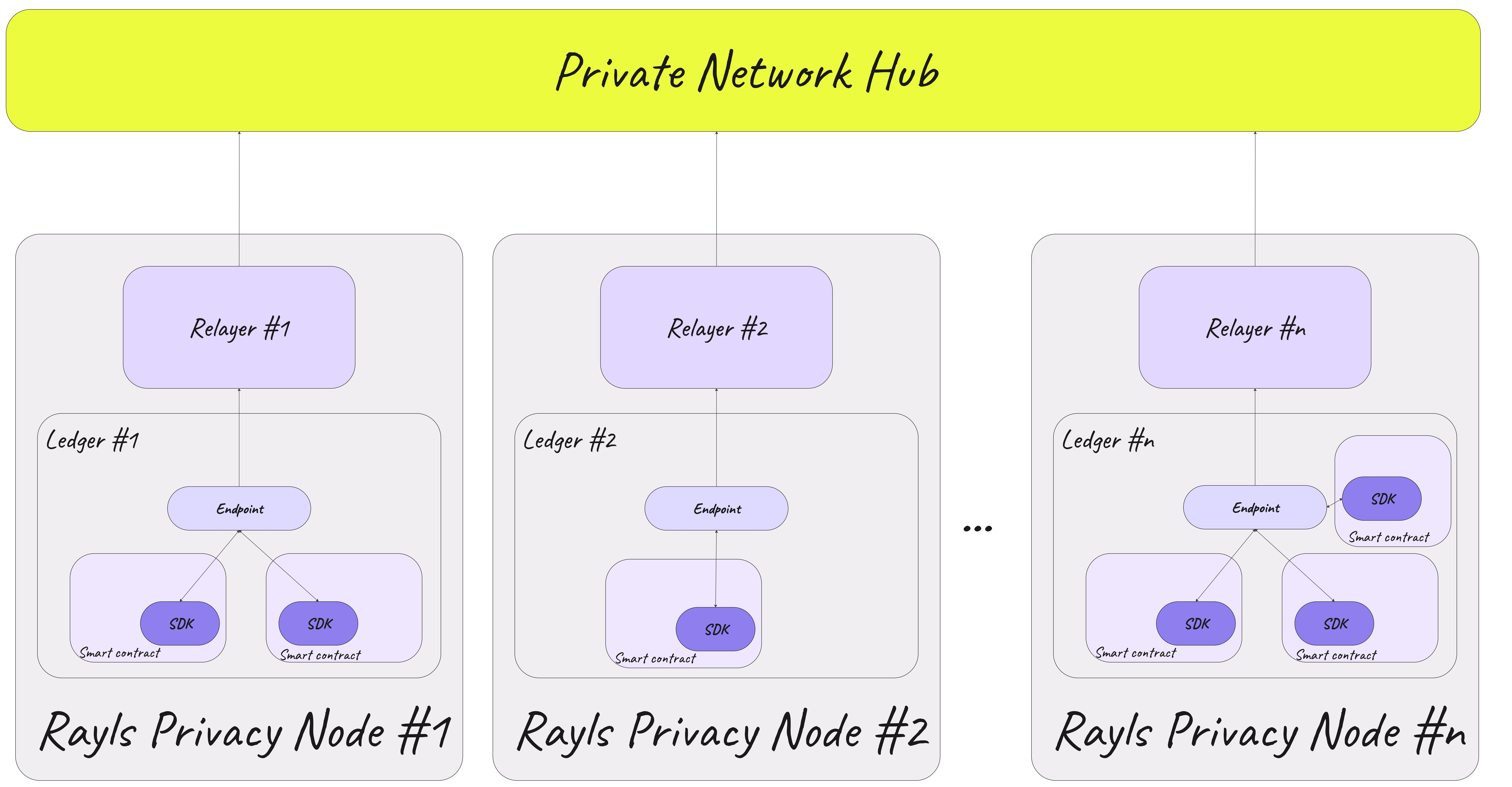
Private Network Hub:
The Private Network Hub sits at the heart of the Rayls Protocol, orchestrating the flow of information and assets between Rayls Nodes and applying advanced encryption so that the flow stays secure and controlled.
Rayls Sovereign ledger:
Each Rayls Sovereign ledger is a dedicated blockchain within the Rayls ecosystem, designed so that an institution can manage its own internal tokenised operations and carry out confidential, permissioned transactions with the ledgers of other institutions.
Endpoint:
The Endpoint Contract is the gateway of the Rayls Protocol, routing messages securely and efficiently between institutions' ledgers through the Private Network Hub.
SDK:
The SDK gives developers the resources they need to integrate their dApps with the endpoints of the Rayls Sovereign ledgers that make up the Rayls ecosystem, and it is built for ease of use.
Updated 15 days ago