
Axyl Technical Specs
Use this page for the specific details on how Axyl works, its layers, transactions flow, and key contracts.
Use this page for the specific details on how Axyl works, its layers, transactions flow, and key contracts.
Consensus Layer
The consensus layer is responsible for ordering transactions and producing a committed sequence of batches. It consists of two components:
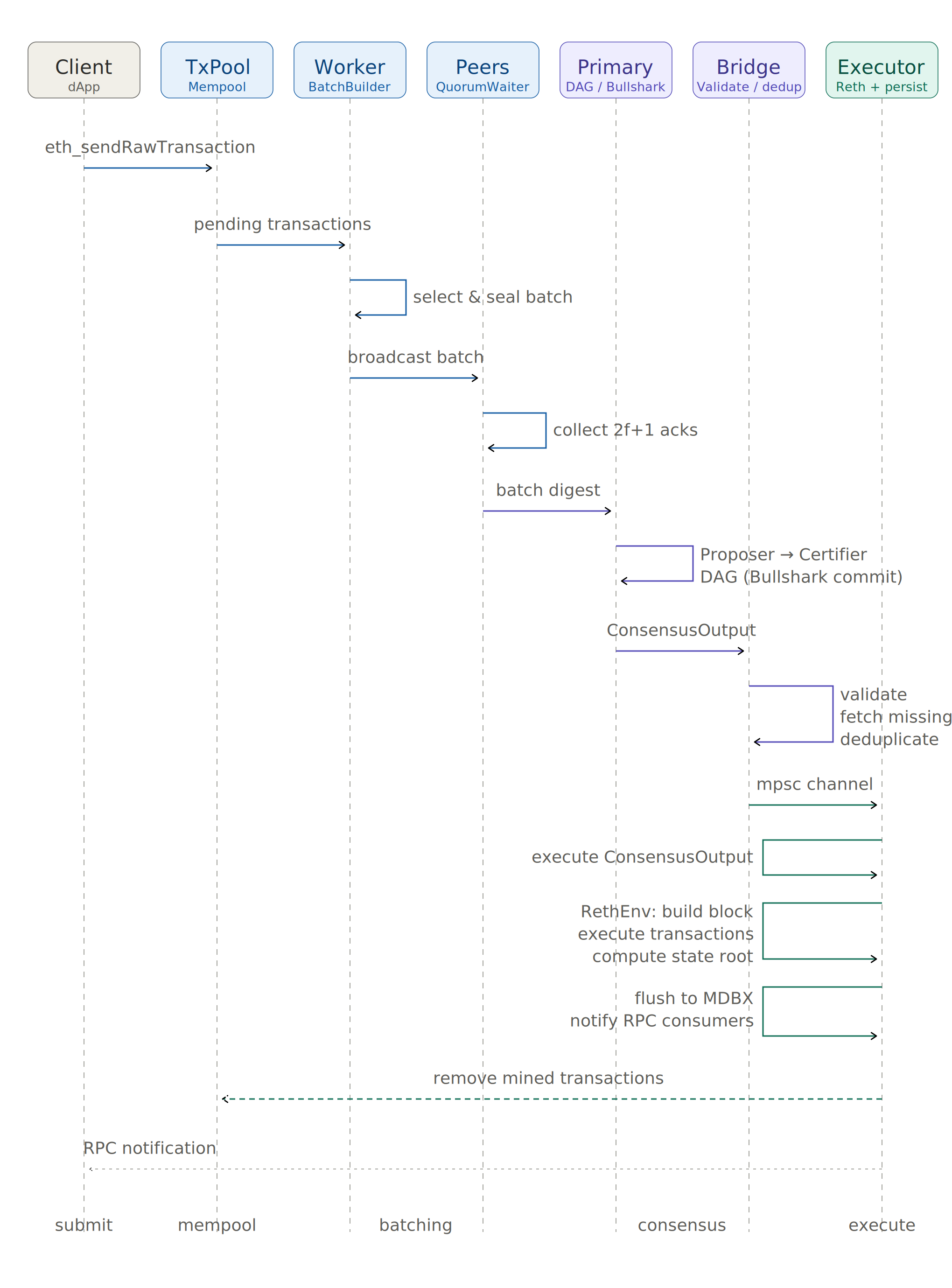
Worker. Each validator runs one or more workers. Workers receive transactions from the mempool (WorkerTxPool), build sealed batches, and broadcast them to peer workers. A batch is considered acknowledged once 2f+1 peers have confirmed receipt, where f is the maximum number of tolerated faulty nodes. Once quorum is reached, the batch digest is forwarded to the Primary.
Primary. The Primary is responsible for building and certifying headers. Each header bundles batch digests and parent certificate references into a DAG (Directed Acyclic Graph) structure. A header becomes a Certificate once it collects enough votes from peer primaries. Certificates accumulate round by round in the DAG, and a committed sub-DAG (called a ConsensusOutput) is produced by the Bullshark commit rule.
Middleware Layer
The middleware layer bridges the consensus and execution layers. It consists of two components:
Bridge (Subscriber). The Bridge subscribes to ConsensusOutput events, validates them, fetches any missing batch payloads, deduplicates outputs, and forwards them to the Executor via an in-process channel.
Processor (ExecutorEngine). The Processor polls the channel and executes one ConsensusOutput at a time on a dedicated blocking thread, which enforces strict sequential execution.
An Orchestrator manages the full node lifecycle, including epoch transitions via a state machine (EpochManager), and exposes the rayls_* RPC bridge between the consensus bus and the execution layer.
Execution Layer
Each batch in a committed sub-DAG maps to one EVM block. Block construction is handled by RethEnv::build_block_from_batch_payload, which:
- Recovers raw transactions from the batch payload.
- Warms the sparse trie in parallel for performance.
- Builds a layered state from CanonicalInMemoryState and the on-disk MDBX store.
- Executes each transaction via RaylsEvm (revm with a native ERC-20 inspector), skipping invalid transactions rather than reverting them.
- Applies EIP-4788 and EIP-2935 pre-execution system calls.
- At epoch boundaries, triggers ConsensusRegistry.applyIncentives and concludeEpoch via system call.
- Computes the state root using a parallel sparse trie.
- Seals the block and inserts it into CanonicalInMemoryState.
Completed blocks are flushed to disk by the PersistenceService and broadcast to RPC consumers via CanonStateNotification.
Transaction flow
A transaction submitted by a client follows this path through the system:
Key invariants
- Transactions are not executed until the consensus layer has committed them. Any transaction found to be invalid at execution time is skipped with no revert and no fee charge.
- One ConsensusOutput maps to one EVM block per batch in the sub-DAG, or to a single empty block if the output carries no batches.
- Blocks within the same consensus round are inserted sequentially, and each block reads the state produced by the previous block in the same round.
- Base fees move per block under the standard EIP-1559 rule, subject to a protocol floor. Only the parameters of that rule, meaning the target gas usage and the adjustment speed, are recalibrated at epoch boundaries.
- Priority fees from batch transactions are credited to the batch author's coinbase address. Block rewards at epoch close are distributed by ConsensusRegistry.applyIncentives via system call.
Epoch model
Axyl organises consensus activity into epochs. Each epoch has a fixed committee of validators. At the boundary of each epoch:
- The EpochManager drives a transition state machine to rotate the active committee.
- The ConsensusRegistry system contract applies validator incentives and closes the epoch.
- An EpochRecord is produced, recording the active and next committee, the last execution block, and the last consensus header of the epoch. This record serves as the trust anchor for light clients and syncing nodes.
- An EpochCertificate (an aggregate BLS signature from at least ⌊2n/3⌋ + 1 committee members) is generated to prove the EpochRecord is authoritative.
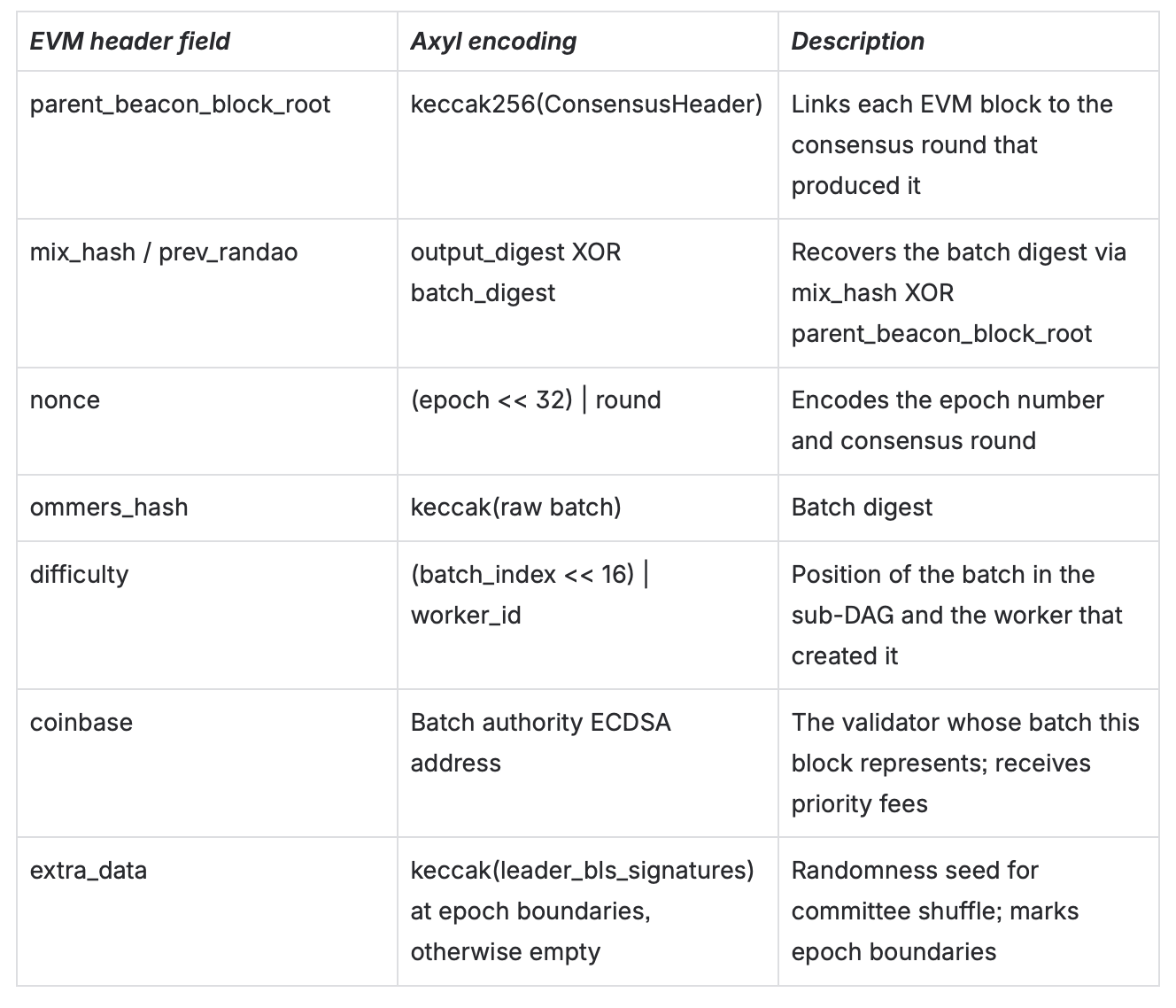
- The extra_data field of the epoch-boundary block encodes a BLS signature hash used as a randomness seed for the new committee shuffle.
Block header encoding
Rather than introducing new storage tables, Axyl encodes consensus metadata into standard Ethereum block header fields, which leaves the standard reth tables unmodified.
Storage
Axyl uses two storage engines alongside Ethereum's standard MDBX tables. Consensus DB (redb by default, MDBX optional) stores all DAG and epoch state, including certificates, votes, batch payloads, committed consensus blocks, and epoch records. Execution DB (reth MDBX) stores standard Ethereum execution state, covering accounts, storage, receipts and so on. This is managed by reth's built-in persistence layer and is unchanged from standard reth.
RPC interfaces
Standard Ethereum RPC
Every Axyl node exposes the full reth EthApi server over HTTP, WebSocket, and IPC. All standard eth_* methods are available.
Rayls namespace (rayls_*)
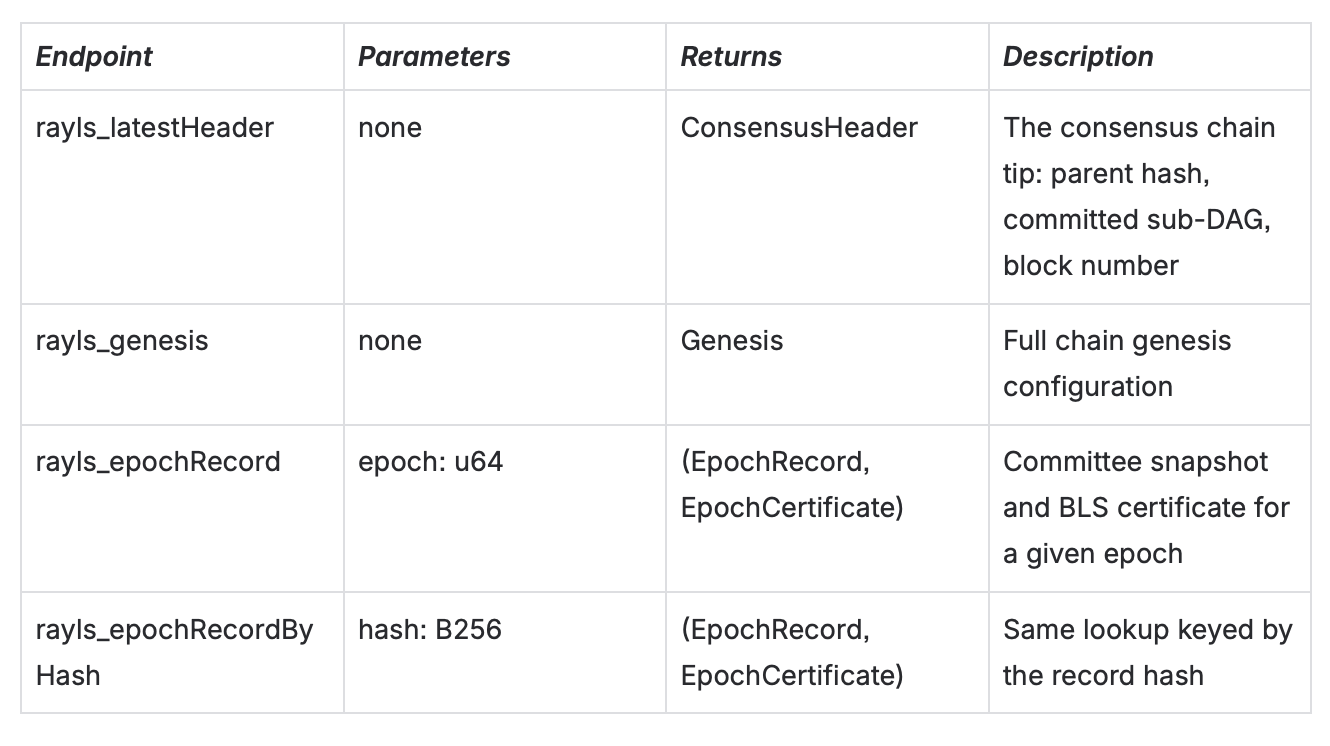
Four additional endpoints expose consensus state not covered by the standard Ethereum API.
System contracts
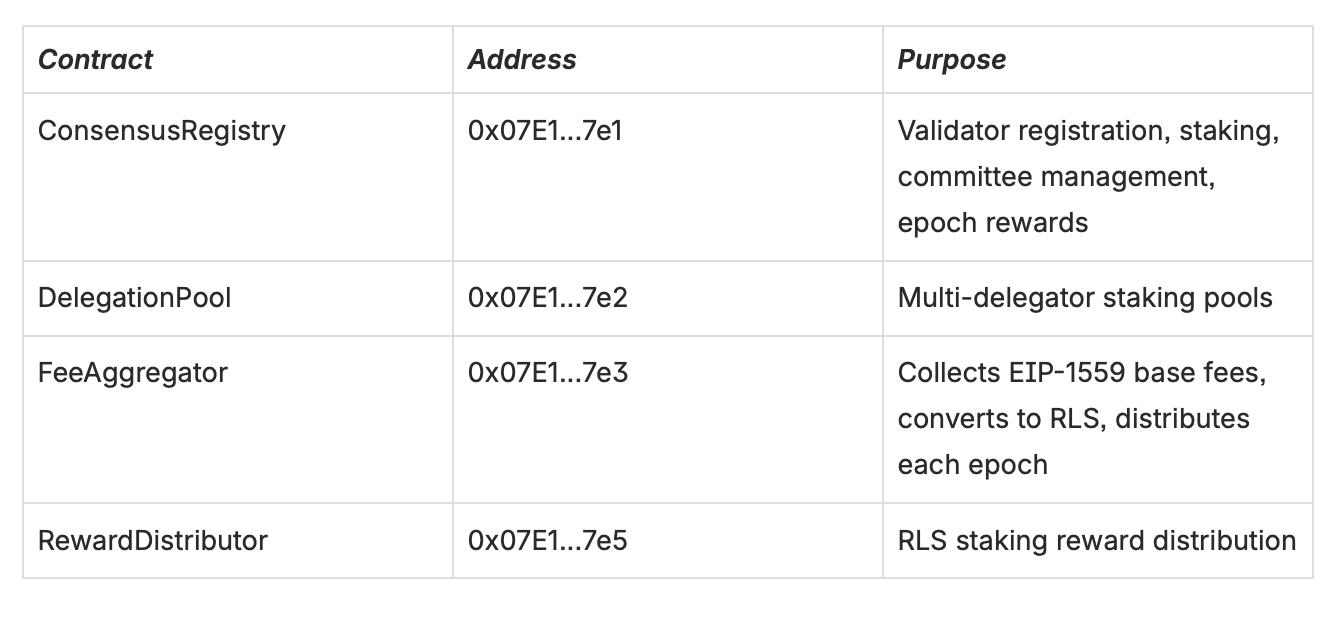
The following contracts are deployed at genesis and driven by EVM system calls at epoch boundaries.
EVM fork configuration
The Axyl chain (chain ID 72957) activates all EVM hard forks at genesis, so the full Ethereum feature set is available from block zero with no upgrade boundaries to account for.
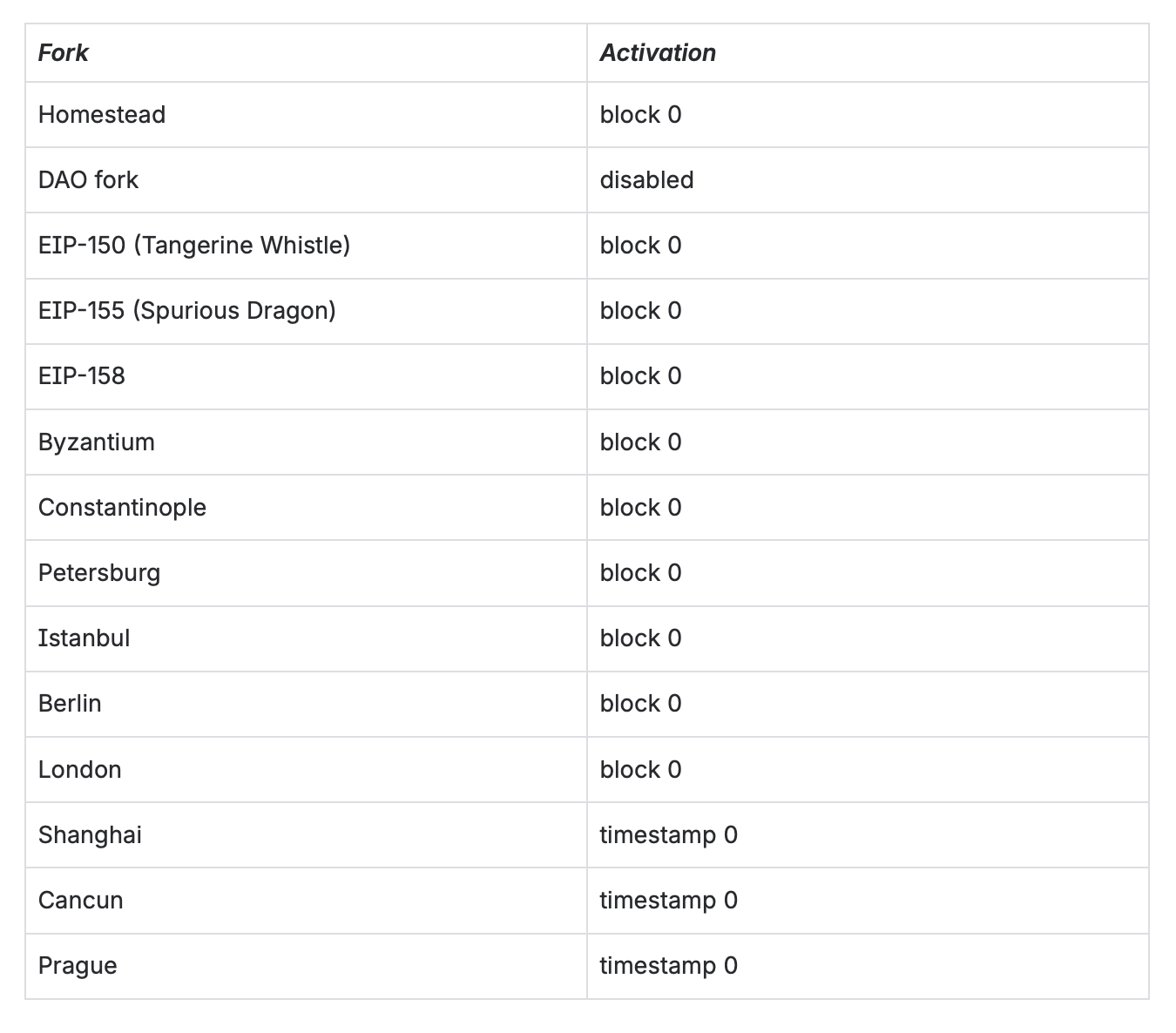
The following EIPs are active from genesis and are directly relevant to dapp developers building on Axyl.
- EIP-1559 (fee market). All transactions use the EIP-1559 fee model. On Axyl, base fees are pegged to USD and collected by the FeeAggregator system contract, which converts them to RLS and distributes them each epoch, so gas costs stay predictable regardless of RLS token price volatility.
- EIP-1271 (contract signature validation). The isValidSignature standard is supported and already used by contracts deployed at genesis, including the Safe multisig at 0x41675c099f32341bf84bfc5382af534df5c7461a. This is a required building block for smart account implementations, including passkey accounts, where the account contract needs to validate signatures on behalf of an EOA.
- EIP-2612 (permit). The permit function (EIP-2612) is implemented in the native RLS token and the wrapped RLS contract (0x5c78ebbcfdc8fd432c6d7581f6f8e6b82079f24a), which enables gasless token approvals via signed messages. This is useful for smart account flows where an approval and an execution need to happen in a single transaction.
- EIP-7212 (secp256r1 / P256 precompile at 0x0000000000000000000000000000000000000100). This enables efficient on-chain verification of WebAuthn and passkey signatures without a Solidity fallback verifier, and it is the most critical EIP for passkey smart account work.
- EIP-7702 (set EOA code). It allows an EOA to temporarily designate contract code, which is useful for hybrid smart account patterns where an existing EOA needs to be upgraded without a full migration.
Updated about 2 months ago