
Rayls
Rayls is the EVM Layer 1 network connecting institutions to blockchain liquidity, with built in privacy and compliance. It is not a single chain and not a single product, but a coordinated set of EVM environments, a privacy framework that runs across them, and the tokens that keep the ecosystem moving. Together they let regulated capital move onchain without giving up the privacy, controls and auditability institutions are required to maintain.
Rayls is designed to bridge Traditional Finance and Decentralised Finance, bringing the roughly $100 trillion of TradFi liquidity into reach of onchain markets, and bringing onchain markets into reach of the institutions that hold it.
Rayls is not a CBDC, not a stablecoin in itself, and not a single-purpose tokenisation network. It is general-purpose infrastructure, EVM-compatible end to end, and built around three environments with distinct permission models.
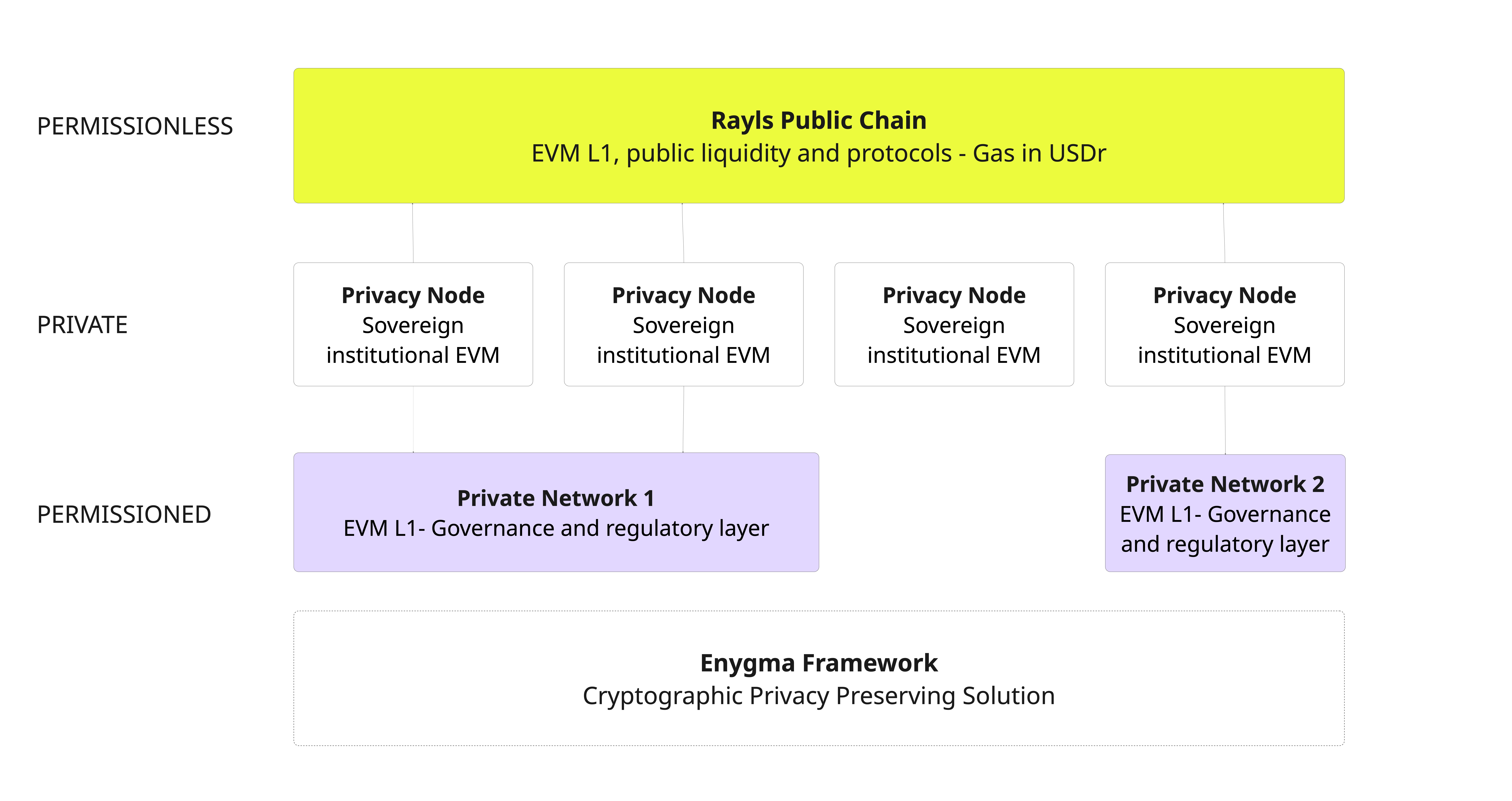
Three layers, three permission models
Rayls Sovereign, private. A sovereign, EVM-compatible blockchain operated by a single institution. Each institution that uses Rayls runs its own Rayls Sovereign ledger. It is high-performance infrastructure that handles the institution's internal activity and produces the cryptographic material (proofs, commitments, encrypted payloads) that allows it to transact privately with others.
Rayls Private Network, permissioned. A governance layer that connects two or more Rayls Sovereign ledgers into a shared EVM Layer 1. Membership is permissioned and the rules are set by the participating institutions, which makes Private Networks the natural place to model jurisdictions and regulatory frameworks. Every transaction inside a Private Network is private by default.
Rayls Public Chain, permissionless. An Ethereum-compatible Layer 1 open to anyone. This is where assets are distributed, where DeFi protocols are deployed, and where institutional and public liquidity meet.
The three layers are interoperable, and Rayls Sovereign is what connects them. A Rayls Sovereign ledger can participate in one or more Private Networks and can also reach the Public Chain, so an institution can issue a tokenised asset privately inside a Private Network and then move it to the Public Chain for distribution, while a protocol deployed on the Public Chain (a vault, a swap pool, a DvP contract) can be consumed from inside a Private Network.
How privacy works across the layers
Privacy on Rayls is delivered by the Enygma Framework, which lives in two places at once.
The cryptographic work happens in the Rayls Sovereign ledger, covering zero-knowledge proof generation, Pedersen commitment storage, key handling, encryption and decryption. The settlement state lives in a pool of smart contracts on whichever chain the transaction settles on, Private Network or Public Chain, and those contracts record that the transaction occurred and that it was valid without revealing the contents.
This is what allows two institutions to transact privately on a public, auditable chain, since the proofs are public and the contents are not.
Settlement and finality
Where a transaction settles depends on where it travels.
- Inside a single Rayls Sovereign ledger, the institution's own chain is the source of truth.
- Between Rayls Sovereign ledgers inside a Private Network, the Private Network is the source of truth.
- Between Rayls Sovereign ledgers via the Public Chain, the Public Chain is the source of truth.
Performance follows from Axyl, the Rayls consensus mechanism. Axyl has been live on the Public Chain since mainnet launch on 30 April 2026, and it was adopted on Rayls Sovereign in July 2026, superseding Clique proof of authority and running alongside the move of the execution client from Geth to Reth. The Private Network Hub continues to run Besu proof of authority for now. Axyl is built for institutional throughput, at 15,000+ transactions per second with sub-second finality.
Validators are separate from Rayls Sovereign
A Rayls Sovereign ledger is not a validator. It is the institution's cryptographic and execution layer, and validation is a separate role. Any institution can choose to run validators on the Private Networks it participates in and on the Public Chain, in addition to operating its own Rayls Sovereign ledger.
Tokens and gas
- RLS is the Rayls native token.
- USDr is the gas token of the Public Chain, a stablecoin issued by Rayls, pegged 1:1 to the US dollar and backed by USDC bridged from Ethereum (USDC.e, via LayerZero). Pricing transactions in a stable unit lets institutions budget onchain activity without exposure to gas-price volatility. Reserves and circulation are published on the Rayls transparency portal, alongside the existing disclosures for RLS.
Rayls Sovereign and Rayls Private Networks are gasless. Institutions running their own Rayls Sovereign ledger, or transacting inside a Private Network they participate in, do not pay gas on those transactions. Gas applies on the permissionless Public Chain, denominated in USDr.
What this enables in practice
Inside a Rayls Private Network, an institution can:
- onboard clients and operate accounts privately,
- issue and hold tokenised assets in standard ERC formats (ERC-20, ERC-721, ERC-1155),
- transact with other institutions on the network with confidentiality and anonymity preserved,
- run the protocols institutions actually need, including payments, DvP settlement, vaults, swap pools, and any other EVM-compatible contract.
EVM compatibility means existing developer tooling, standards and audited contract patterns carry over, so teams do not need to learn a bespoke stack to build on Rayls.
In production
Rayls is backed by financial institutions in Brazil and is in active production deployment with institutions including:
- XP Inc. - USDXP stablecoin
- Núclea - Brazil's largest payment FMI, supporting 150+ financial institutions
- AmFi - tokenised over $500M in credit and debt instruments
The ecosystem, at a glance
| Component | Permission model | Role |
|---|---|---|
| Rayls Sovereign | Private (single institution) | Sovereign EVM ledger. Runs the Enygma cryptography. Gasless. |
| Rayls Public Chain | Permissionless | Ethereum-compatible L1. Public liquidity and protocol layer. Gas in USDr. |
| Rayls Private Network | Permissioned (group of institutions) | Governance layer connecting Rayls Sovereign ledgers. Models jurisdictions and regulatory frameworks. Private by default. Gasless. |
| Rayls Enygma Framework | Cross-layer | Privacy framework. Cryptography in the Rayls Sovereign ledger, settlement state on chain. |
| RLS | n/a | Rayls native token. |
| USDr | n/a | Stable gas token for the Public Chain, pegged 1:1 to the US dollar and backed by USDC bridged from Ethereum. |
Where to go from here
- If you're evaluating Rayls for an institution, start with Rayls Sovereign and the Enygma Framework.
- If you're building on Rayls, start with the Rayls Public Chain and how to get USDr.
Updated 5 days ago